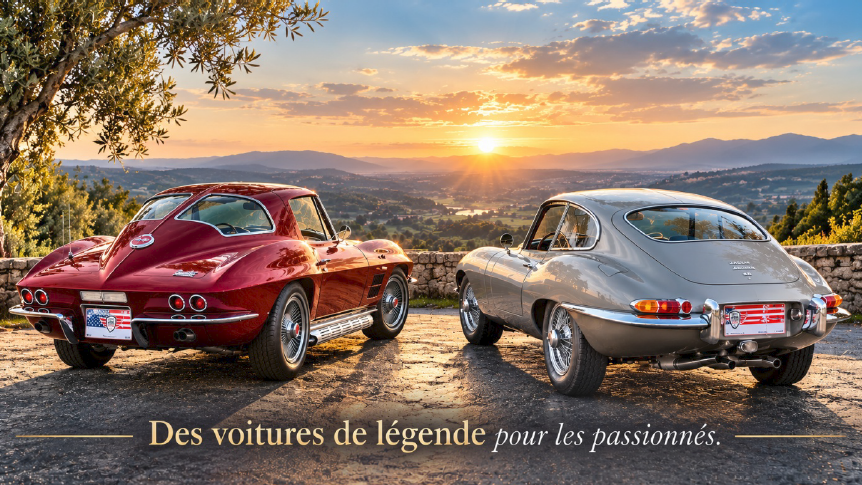
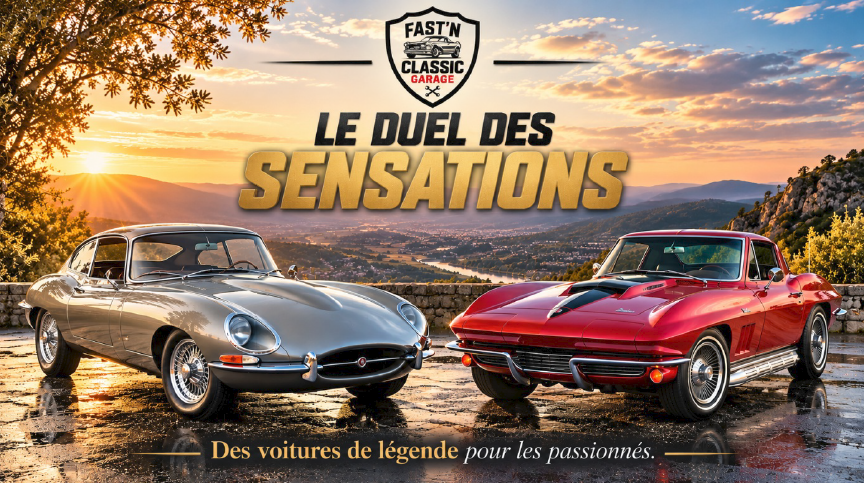
America versus England. The V8 versus the six-cylinder. Power versus elegance. In the 1960s, two automakers created cars that have since become legendary. Even today, the Chevrolet Corvette C2 and the Jaguar E-Type continue to capture the imagination of car enthusiasts. But which one best embodies the classic sports car?
Imagine a head-to-head showdown, Top Gear-style.
On one side, a 1967 Chevrolet Corvette Sting Ray, with its long hood, sculpted fenders, and massive 7-liter V8 engine.
On the other side, a 1965 Jaguar E-Type, instantly recognizable with its elongated silhouette, sensual curves, and big-cat-like presence.
Two cars, two automotive cultures, and one shared goal: to deliver an exceptional driving experience.
ROUND 1 — STYLE: AMERICAN MUSCLE OR BRITISH ELEGANCE?
Introduced in 1963, the Corvette C2 marked a new chapter in Chevrolet's history. Its spectacular design broke with the rounder lines of the first generation. The car exuded a bold, almost aggressive personality that immediately evoked performance.
The 1967 model, the final iteration of this generation, is particularly sought after by enthusiasts. With its low profile, endless hood, and athletic proportions, it perfectly embodies the spirit of American sports cars from the 1960s.
Compared to it, the Jaguar E-Type is in a league of its own.
Unveiled in 1961, it caused a sensation with its design by Malcolm Sayer. Its aerodynamic profile, long hood, and rear-set cockpit give it exceptional elegance. Its silhouette has become one of the most recognizable in the history of the automobile.
The Corvette is impressive. The Jaguar is fascinating.
Initial verdict: personal preference wins out. Fans of bold, muscular lines will choose the American model; those who prefer timeless elegance will likely have a soft spot for the British one.
ROUND 2 — UNDER THE HOOD: THE AMERICAN V8 VS. THE BRITISH SIX-CYLINDER
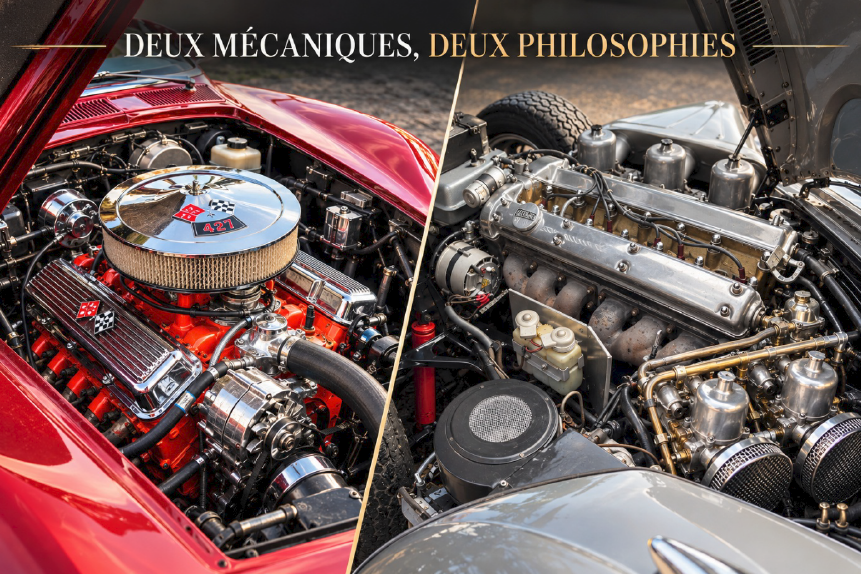
This is where the two philosophies truly diverge.
In its 427 Big Block version, the Corvette is equipped with a 7.0-liter V8 engine. Depending on the configuration, the advertised power ratings for the 427 models of that era vary. This engine is renowned for its generous displacement, high torque, and distinctive sound.
Paired with a manual transmission, it offers a driving experience deeply rooted in American tradition: expressive handling, impressive power reserves, and a personality that doesn't go unnoticed.
The 1965 Jaguar E-Type Series 1 takes a different approach with its 4.2-liter inline-six engine, which produces 269 ch in this configuration.
This model, introduced in 1964, delivers more torque than the previous 3.8-liter version. The fully synchronized transmission also enhances driving comfort.
The Jaguar thus prioritizes smoothness and mechanical harmony without sacrificing performance.
The Corvette relies on the power of its V8. The Jaguar appeals with its overall balance.
Two engines, two distinct characters, but the same era when automakers still dared to give their cars a true personality.
ROUND 3 — ON THE ROAD: TWO WAYS TO LIVE OUT YOUR PASSION
Driving a C2 Big Block Corvette means rediscovering the spirit of classic American sports cars: powerful performance, a distinctive sound, and a commanding presence that is an integral part of the experience.
The Corvette embraces its spirited nature. It’s designed for those who love to feel the engine come alive and who are looking for a car with character.
The Jaguar E-Type offers a different kind of driving experience. Its six-cylinder engine, elegant lines, and sporty design make it a car that invites you to enjoy the drive as much as the destination.
But beware of common misconceptions: a classic car isn't judged solely on its power or prestige. Its mechanical condition, maintenance, braking, and the quality of its restoration play a crucial role in driving pleasure and safety.
And in this regard, each copy deserves special attention.
ROUND 4 — WHICH ONE SHOULD YOU CHOOSE TODAY?
That's the question every enthusiast eventually asks themselves.
The Corvette C2 appeals to those who dream of an American V8, spectacular styling, and a car that epitomizes American sports car culture.
The Jaguar E-Type will appeal most to enthusiasts of design, British sophistication, and six-cylinder engines.
As for their collectible value, it’s impossible to pick a winner without examining the specific vehicles in question, their authenticity, their condition, their history, and the market for comparable cars.
These two models hold a special place in automotive history. But their value isn't based solely on their reputation: the quality of each car is just as important.
THE FAST’NCLASSIC VERDICT: DO YOU REALLY HAVE TO CHOOSE?
So, Corvette or Jaguar?
The Chevrolet Corvette C2 Sting Ray embodies American power in all its glory. The Jaguar E-Type embodies British elegance and a particularly refined approach to sports car design.
One speaks to the hearts of V8 enthusiasts. The other appeals to those who see the automobile as a fusion of mechanics and beauty.
What if the real answer were simply that there is no wrong choice between two legends as different as these?
At FAST’NCLASSIC, we firmly believe that the most beautiful cars are those that evoke a lasting emotion, far beyond the numbers listed on a spec sheet.
And you—in your garage—which would you choose: the quiet power of the American Big Block or the feline elegance of the Jaguar E-Type?
Check out our two listings and fall in love with these distinctive cars.